SureFit Appliance Services repairs all stacked configurations across Ontario, from York Region to the GTA. Our technicians handle everything from access challenges to complex component failures. We’ll walk you through the basics so you can understand what your laundry appliances need.
Three Types of Stackable Washer Dryer Configurations
Not all stacked laundry units are built the same. Each design creates distinct stackable washer dryer repair implications.
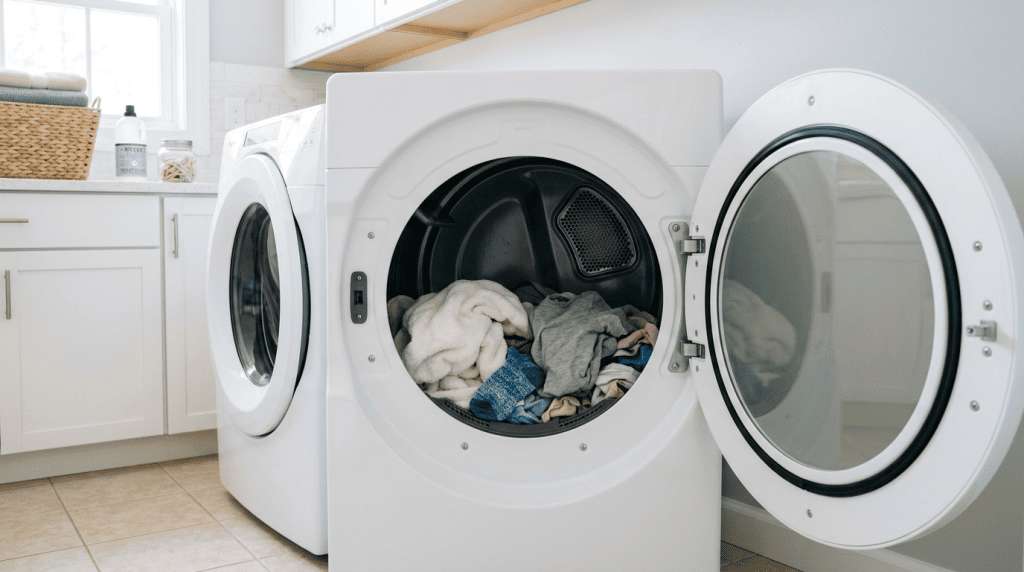
Stacked Front-Load Washer and Dryer Pair
Two separate machines connected with a stacking kit represent the most common setup. The washer sits on the floor, and the dryer sits on top, held in place by a metal or plastic frame. Both machines operate independently — they share no mechanical or electrical connections.
This design is popular because it’s affordable and flexible. You can remove the stacking kit and use the machines side-by-side if needed. Repair access is moderate since unstacking is always possible.
Laundry Centre (Factory-Integrated Unit)
A laundry centre is a single heavy unit with the washer and dryer built as one frame. The washer (top-load or front-load) sits below, and the dryer sits above it. The two components are structurally bonded during manufacturing.
Brands like Whirlpool and Maytag manufacture reliable laundry centres. They’re mechanically simpler than stacked pairs, but they’re much heavier. Moving them during repair requires special equipment and technique.
All-in-One Washer-Dryer Combo
A single drum performs both washing and drying in one cycle. These units are ventless — moisture condenses into a drain pan rather than venting to the outside. Drying takes 3 to 4 hours per load, but space consumption is minimal.
All-in-one combos occupy the smallest footprint but have longer cycle times. Repair costs are higher relative to their capacity due to complex internal mechanisms.
Access Challenges That Affect Stackable Washer Dryer Repair Time and Cost
The biggest difference between stacked and freestanding units is access. Technicians often need to pull apart or move your appliances to diagnose problems.
Getting Inside a Stacked Pair
To reach the motor, drum, thermal fuse, or rear seal of a stacked dryer, the dryer must come down. This requires two people, proper lifting technique, and careful handling of water and electrical connections below. The job becomes more complex if you need heating element replacement or blower wheel service.
Rusted stacking kits or machines wedged in tight corners take even longer to separate. Plan for a service call to take 45 minutes to over an hour just for access — before repair work begins.
Moving a Laundry Centre
Factory-integrated units weigh 200+ pounds. We pull them from the wall to access the back panel, blower wheel, and ductwork. This single-unit design means no separate unstacking step, but the sheer mass makes positioning slower.
Laundry centres require furniture dollies and protective floor coverings. The work area needs to be clear before the technician arrives.
Service Call Length for Stacked Appliances
Don’t be surprised if stackable washer dryer repair takes longer than freestanding service. Access difficulties are real and unavoidable. An honest service call estimate will account for this upfront — something SureFit does when we quote every job.
Common Stackable Washer Dryer Repair Problems
Vibration and Walking
Front-load washers create vibration, especially on the spin cycle. When a dryer sits on top, that vibration amplifies throughout the stack. An unbalanced load makes the problem worse — the entire stacked unit can shift or “walk” across the floor.
Before calling for service, check these items:
- Verify the stacking kit is fully engaged and all bolts are tight
- Make sure the washer is level using a spirit level on top of the unit
- Place anti-vibration pads under the washer’s legs
- Distribute laundry evenly and avoid overloading the drum
If vibration persists after these checks, the washer’s suspension springs or shock dampers may be worn. This requires professional repair and often means replacing multiple components at once.
Stacked Dryer Not Heating
When a stacked dryer stops heating, homeowners often assume the thermal fuse has blown. In most cases, the real culprit is a restricted vent system.
Stacked dryers sit high on the wall. The ductwork behind them often includes 90-degree bends to route air from the dryer to the outside. Each bend creates friction equivalent to about 5 feet of straight duct, and lint accumulates faster in these tight corners.
We recommend professional vent cleaning annually for stacked setups — more often if you dry heavy loads regularly. Proper vent maintenance prevents most heating-related stackable washer dryer repair calls.
Condensation Leak on Laundry Centres
On integrated laundry centres, the dryer sits directly above the washer. When the dryer’s condensation drain becomes clogged, water drips into the washer below. The drain pan may also crack or pull loose from the dryer body over time.
This problem is specific to factory-integrated units. It requires careful disassembly to access the condensation system and replace damaged components.
Vent Maintenance for Stacked Dryers
Ductwork design matters more for stacked dryers than for freestanding models. Poor venting is a leading cause of stackable washer dryer repair calls.
A typical wall installation requires the dryer duct to travel horizontally behind or beside the stacked unit, then make at least one 90-degree turn to exit the home. Some layouts require two or three bends to clear cabinets or plumbing.
Every 90-degree bend adds resistance. Lint builds up faster in these zones, and over time, the vent becomes partially or fully blocked. The dryer works harder and heats less efficiently.
Signs of a restricted vent include:
- Clothes take longer to dry (add 10+ extra minutes per load)
- Dryer feels hot to the touch externally
- Lint appears around the dryer door or seals
- A burning smell during operation
Professional vent cleaning removes lint, pet hair, and debris from inside the ductwork — not just the visible filter. This maintenance prevents most heating element and thermal fuse failures.
When to Unstack for Repair vs Service in Place
Not every stackable washer dryer repair requires unstacking the units.
Service in Place (No Unstacking Needed)
- Cleaning or replacing the lint filter
- Wiping the rubber door gasket
- Clearing the moisture sensor
- Inspecting the duct connection at the back
- Testing electrical connections at the control panel
Unstacking Required
- Replacing the thermal fuse, heating element, or blower wheel
- Repairing the drum, drum roller, or felt seal
- Replacing the motor or drive belt
- Accessing the control board for electrical diagnostics
- Servicing the wash pump or drain system on the washer below
A qualified technician will tell you upfront whether unstacking is necessary. If it is, we provide a clear estimate of time and labour before starting work.
Brand-Specific Notes on Stacked Repair
Samsung and LG Stacked Pairs
Both brands deliver strong performance in stacked configurations. Parts are widely available through our suppliers, and repair costs are moderate. We service Samsung and LG models throughout our 200-kilometre service radius from Keswick.
Common repairs include door latch replacement, drain pump service, and control board diagnostics. Both brands use similar stacking hardware that rarely fails.
Whirlpool and Maytag Laundry Centres
These factory-integrated units are mechanically straightforward and hold up well over time. Repairs tend to be affordable because the designs are proven and parts are common in our inventory.
The most frequent calls involve belt replacement, idler pulley service, and moisture sensor cleaning. These brands prioritize serviceability in their engineering.
Miele Stacked Units
Miele appliances are premium — and they’re built to last decades. When repair is needed, the engineering is sophisticated and the parts cost more. However, Miele units are absolutely worth repairing given their longevity.
They require careful handling during service due to their construction and weight. We stock common Miele parts and work with their technical support when needed.
Frequently Asked Questions
Can a stacked dryer be repaired without unstacking it?
Sometimes. Minor maintenance like filter cleaning or duct inspection doesn’t require unstacking the units. Any internal repair — thermal fuse, bearing, motor, or drum-related work — requires removal of the dryer from the stacking kit. Your technician will assess this during the initial diagnosis and explain the process before proceeding.
Why is my stacked laundry unit so loud?
Stacked units amplify noise because the dryer vibrates while sitting on the washer below. Loose bolts on the stacking kit, a worn dryer drum bearing, or an unbalanced washer load can all cause excessive noise. We inspect the stacking kit first — tightening bolts often solves the problem. If noise continues, the dryer’s bearing or idler pulley may need replacement.
Are all-in-one washer-dryers worth repairing?
It depends on the repair cost and the unit’s age. All-in-one combos are convenient but have higher repair expenses because the internal mechanics are complex. If the unit is under five years old and the repair cost is less than 50% of a replacement, repair makes financial sense. For older units with expensive failures, replacement may be more practical.
How do I know if my dryer vent is restricted?
The clearest sign is longer drying time — clothes that used to dry in 30 minutes now take 45 or more. The dryer exterior may feel unusually hot during operation. You might also notice a burning smell during cycles or lint accumulation around the dryer seals. A professional vent inspection uses a camera to confirm blockages and measure airflow.
How much does stackable washer dryer repair cost?
Our service call is $85 + HST per appliance, waived if you proceed with the repair. Repair costs depend on the specific problem — simple fixes like belt replacement run $150-250, while major component replacement (heating element, motor, control board) can range $200-400. We provide a written quote before any work begins, so you’ll know the exact cost upfront.
Professional Stackable Washer Dryer Repair Service
Stacked washers and dryers need experienced hands for proper service. SureFit Appliance Services has repaired hundreds of stacked setups across the GTA, York Region, Simcoe County, and surrounding areas. We’re TSSA certified for gas and propane appliances and work on all major brands — Samsung, LG, Whirlpool, Maytag, Miele, Bosch, KitchenAid, and more.
Our technicians come prepared with the tools needed to safely unstack and service your appliances. Same-day appointments may be available. Every completed repair comes with our 90-day parts and labour warranty.
No hidden fees, no surprises. You’ll receive a written quote before any work begins, and our diagnosis fee is clearly stated upfront at $85 + HST per appliance.
Same-day appointments may be available. Emergency requests are reviewed before scheduling is confirmed.schedule your stackable washer dryer repair online!
Learn more about our washer repair services and dryer repair expertise.