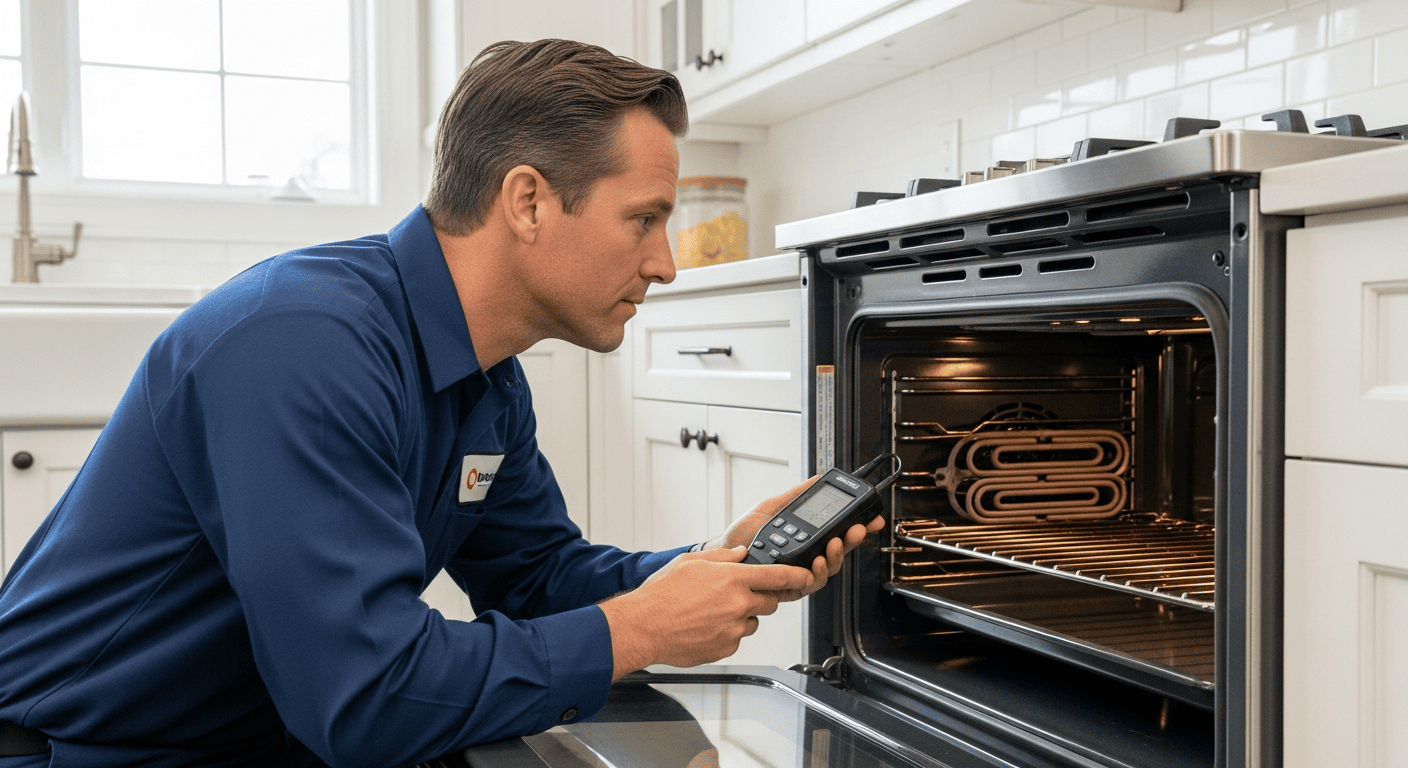
Thermador ovens, ranges, and wall ovens use a standardized error code system. Understanding these codes helps you determine whether a simple reset will work or if you need professional repair.
How Thermador Displays Error Codes
Thermador’s display method depends on your model and age.
Newer models (wall ovens, PRD gas ranges, steam ovens) show error codes directly on the digital display panel. You’ll see a code like “E102” or “F11” clearly visible.
Older PRG gas range models may use indicator lights instead of numeric codes. A pattern of blinking lights corresponds to a specific fault. Check your manual to decode the light sequence.
In both cases, the error code appears when the control board detects a problem during operation or self-diagnostics. Some codes trigger a shutdown for safety. Others allow continued operation but alert you to a failing component.
Most Common Thermador Oven Error Codes
E102 and E103: Oven Temperature Sensor Faults
E102 indicates an open circuit in the oven temperature sensor (NTC probe). This means the sensor has disconnected, failed internally, or the wiring harness is severed.
E103 signals a short circuit — the sensor is shorting to ground or another conductor, sending false temperature readings to the control board.
Both codes prevent normal baking because the oven cannot monitor temperature reliably. The oven may refuse to heat or cycle erratically.
What to try first: Power off the oven at the breaker for 30 seconds, then power it back on. If the code returns immediately, the sensor or wiring has a real fault. Do not attempt to replace the sensor yourself — the probe sits deep inside the oven cavity and requires partial disassembly.
When to call us: Right away. We replace the NTC sensor and test the circuit. Our repair includes a 90-day parts and labour warranty on every completed job.
E104: Oven Overheated (Safety Thermostat Triggered)
E104 means the oven cavity temperature exceeded the safety limit. The mechanical thermostat shut down the heating elements to prevent damage or fire risk.
This can happen if:
- The temperature sensor (E102/E103 fault) sends a false reading, and the oven over-heats trying to reach setpoint.
- The bake heating element stuck on.
- Insulation inside the oven cavity has degraded.
- The self-cleaning cycle ran too long or malfunctioned.
What to try first: Allow the oven to cool completely. Turn it off at the breaker for 10 minutes. Power it back on and set to a low temperature (200°F / 93°C) to see if normal operation resumes.
If E104 returns: Do not ignore it. The safety thermostat reset itself, but the underlying cause remains. The bake element may be failing, or the sensor may have sent false data. A technician should inspect both components.
E105 and E106: Door Lock Faults
E105 means the door lock mechanism will not engage or disengage. This typically occurs during a self-cleaning cycle, which requires the door to lock for safety.
E106 points to the door lock motor itself — the motor is not responding to control board commands, likely due to internal failure or a broken gear.
Without a working door lock, you cannot run self-clean cycles. The oven may also prevent the door from opening properly.
What to try first: Check that nothing is blocking the door latch or strike plate — food debris or a bent hinge can jam the lock. Clean around the latch area. Try opening and closing the door several times.
When to call us: If the latch is clear but the lock still doesn’t move, the motor has failed. We replace the door lock assembly. This repair typically takes under two hours.
E107: Communication Error Between Control Boards
Thermador ovens have multiple control boards — a main control board and secondary boards for the door lock, heating elements, or fan. E107 appears when these boards cannot communicate with each other.
Usually the culprit is a loose or corroded wiring harness connection inside the oven cabinet.
What to try first: Power cycle (off at breaker for 30 seconds, then back on). If the code persists, the harness connection has a real fault.
When to call us: Do not attempt to disconnect harnesses yourself — you may damage connector pins. We identify the faulty connection, reseat or replace the harness, and retest the system.
Heating Element and Fan Error Codes
E120 and E121: Cooling Fan Faults
E120 indicates the cooling fan (cavity fan that runs after the bake cycle) is not working. E121 means the fan’s speed sensor has failed — the fan may run, but the control board cannot measure its speed.
Without cooling airflow, the oven cavity takes much longer to cool after cooking. Heat buildup can damage nearby cabinetry or trigger E104 errors on the next use.
What to try first: Check that the fan grille (on the back or side of the oven) is not blocked by dust or debris. Vacuum the grille and any visible fan blades. Power cycle the oven.
If E120 or E121 persists: The fan motor or sensor needs replacement. This is not a DIY job — the fan assembly is tucked behind the oven exterior panels.
F23, F26, F27: Heating Element Circuit Faults
F23 is a bake heating element circuit fault — the element is shorted, open, or drawing excessive current.
F26 indicates a broil element fault.
F27 signals a convection heating element circuit fault (in convection and steam oven models).
All three codes mean the heating element has failed or the circuit board has lost control of the element.
What to try first: Power cycle. If the code returns, the element is bad. No reset will clear it.
When to call us: We replace the faulty element and verify the circuit. Replacement typically takes 1.5 to 2 hours depending on the element location.
Control Board Error Codes
F01: EEPROM Read/Write Fault
The main control board has a memory chip (EEPROM) that stores programming and settings. F01 means the board cannot read or write to this memory — usually due to a power surge, internal chip failure, or corrupted data.
What to try first: Power cycle the oven. If the code returns, the chip is failing.
When to call us: The control board must be replaced. We order the part and reprogram it with your oven’s settings. Many control boards are in stock thanks to our extensive parts inventory.
F11: Stuck Relay on Main Control Board
A relay is an electrical switch on the control board. F11 means one of these relays is stuck in the “on” position, potentially causing the oven to heat continuously or behave unpredictably.
What to try first: Unplug the oven for 10 minutes, then plug it back in. Stuck relays sometimes release after a hard reset.
If F11 returns: The relay has physically welded itself closed. The control board needs replacement. Do not operate the oven — continuous heating is a fire hazard.
Steam Oven Error Codes
E132 and E133: Steam Generator Faults
Thermador steam ovens and combination steam-convection models include a steam generator — a heating chamber that produces steam for cooking.
E132 signals a fault with the steam generator. Usually this is scale buildup (mineral deposits from hard water) blocking the heating element or water inlet. The heating element itself may also have failed.
E133 means the steam generator is overheating — runaway heating that the thermostat cannot control. This is often a stuck heating element or a failed temperature sensor inside the generator.
Prevention: Descale your Thermador steam oven every 3–6 months using the built-in descaling cycle or a commercial descaler. Hard water accelerates scale buildup.
What to try first: Run a descaling cycle (consult your manual for the exact steps — usually accessed via menu). If E132 or E133 persists after descaling, the heating element has failed.
When to call us: We descale the steam generator, inspect the heating element and sensor, and replace components as needed. Steam generator repair often costs less than a full board replacement.
Why Thermador and Bosch Error Codes Overlap
Thermador is owned by BSH Hausgeräte (Bosch and Siemens Home Appliances). Many Thermador ovens share the same control board platform as Bosch ovens — particularly the PRD gas ranges and ME wall ovens.
This is good news for repair speed and cost.
Because we service both Thermador and Bosch appliances, we stock common parts. Same-day appointments may be available. SureFit confirms timing after reviewing your request.
The error codes are identical between brands for this reason. If you own both Thermador and Bosch appliances, this guide applies to both.
Can I Clear a Thermador Oven Error Code Myself?
Some codes clear with a power cycle (breaker off for 30 seconds). These are temporary faults — a sensor glitch, a momentary power dip, or a false reading.
Codes like E102, E103, F01, F11, and F23 do not clear on their own. The component has failed. Forcing a reset without fixing the underlying issue risks safety — an overheating oven (E104) or a stuck relay (F11) can cause fire damage.
Always address a code that returns after a power cycle. Do not ignore it hoping it goes away.
Service for Thermador Ovens Across York Region and Beyond
Based in Keswick, Ontario, SureFit Appliance Services covers a 200-kilometre radius including the GTA, York Region, Durham Region, Simcoe County, and Grey County. We service all major Thermador models — PRD gas ranges, wall ovens, steam ovens, and combination units.
Our TSSA certification allows us to safely work on gas-powered Thermador ranges and cooktops. We also stock parts for all major brands including Samsung, LG, Whirlpool, Maytag, KitchenAid, GE, Frigidaire, Bosch, Miele, Sub-Zero, Wolf, Viking, Jenn-Air, Fisher & Paykel, and more.
We charge $85 + HST per appliance for service calls — waived if the repair proceeds. No hidden fees. You receive a written quote before any work begins.
Frequently Asked Questions About Thermador Oven Error Codes
Got a Thermador oven error code that won’t clear? We diagnose and fix all Thermador oven problems. Call (647) 977-2626 or book your appointment online for fast, professional repair!